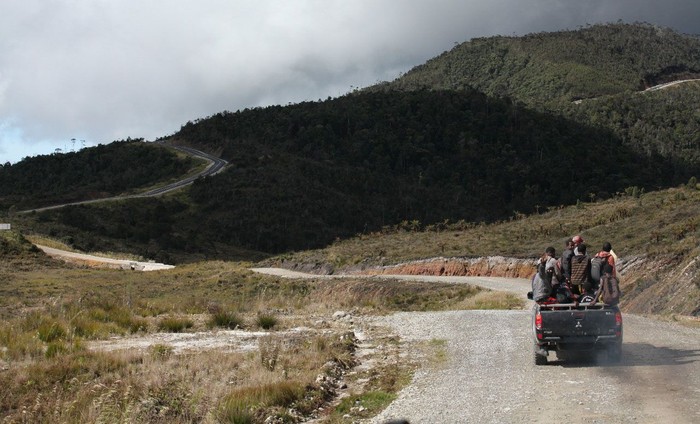
On some routes in Papua’s highlands, the Trans-Papua Highway (Trans-Papua Road) has turned journeys of several days on foot into a few hours by car. Before the road, people in remote districts walked for days or paid for small planes to reach a town. This article looks at how much Trans-Papua travel time has fallen on routes with published figures, which link is still unfinished, and what makes the work slow and risky. For the length and paving status of the whole network, see Trans-Papua Road, Youtefa Bridge and Palapa Ring.
How much travel time has the road saved?
Two highland routes have published before-and-after figures.
| Route | Before the road | After the road | Source |
|---|---|---|---|
| Wamena – Mbua (Nduga), about 90 km | Up to a month on foot | One day | Jayawijaya regent, via Kompas, May 2017 |
| Wamena – Nduga, about 260 km | Four days and four nights on foot | 5–6 hours | President Joko Widodo, via detikFinance, May 2018 |
According to Kompas, the then regent of Jayawijaya, John Wempi Wetipo, said in 2017 that residents of Mbua once walked for up to a month to reach Wamena. The 90-kilometre road cut that to a single day. A year later, President Joko Widodo told truck drivers that the 260-kilometre trip from Wamena to Nduga, once four days and nights on foot, now took five to six hours.
These are official estimates from the time the sections opened. Actual journeys still depend on weather, road condition and security.
Who builds the road?
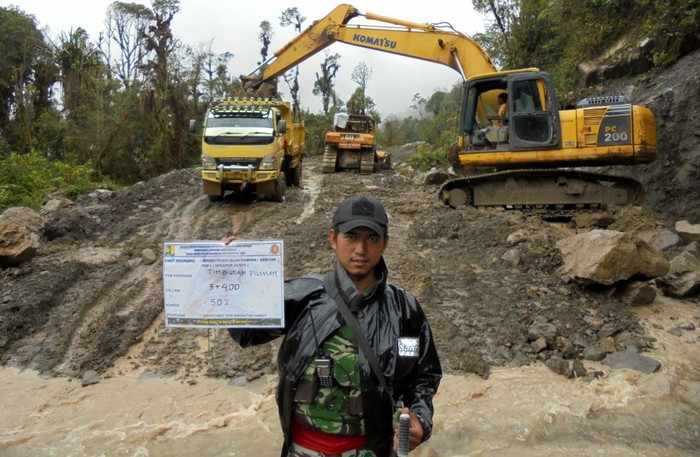
Building roads across Papua requires strong technical skill, because many routes cross steep mountains and thick rainforest. The Ministry of Public Works leads planning and construction. Meanwhile, army engineers support the work by clearing difficult land and building bridges in remote zones. As a result, once-isolated towns gain a land link to regional centres.
👉 ALSO READ: Digital Payments in Papua: How QRIS Reaches Rural Market Stalls
Which link is still unfinished?
The road between Jayapura, the provincial capital, and Wamena in the highlands is one of the most important missing links. In October 2025, Public Works Minister Dody Hanggodo said he aimed to finish the Jayapura–Wamena road in the second half of 2026, Antara reported. The project uses a public-private partnership, and construction had started on several segments.
However, the minister admitted that work was not going smoothly. Land issues were not fully settled, and there were occasional security disturbances. He said security forces supported the project and that his ministry was seeking dialogue with customary leaders to resolve land claims. He added that roads are needed first before the four new Papuan provinces can develop.
Why is building the road risky?
Road building in parts of the highlands has cost lives. In December 2018, an armed group attacked workers of the state contractor Istaka Karya who were building a Trans-Papua bridge in Yigi district, Nduga regency. Police and the military confirmed at least 20 deaths, BBC News Indonesia reported. The attack shows why security remains part of the cost and timing of the road.
Are shorter travel times enough?
Shorter journeys alone cannot solve every transport problem in Papua. Heavy rain, mud, maintenance needs and a lack of local trucks can still slow travel after construction ends. Yet reliable roads create the base needed to tackle these problems. Regular upkeep and proper transport services keep the routes open. In addition, local village leaders need a say in which roads need attention most.
What comes next?
Over the next year, the key test is whether the Jayapura–Wamena link opens as planned. If it does, goods and people could travel between the coast and the highlands by land, which would change how Wamena and the surrounding districts are supplied.