Papua Movement publishes this explainer on 1 December in Papua. Our publisher, the Youth Foundation for Indonesian Peace (YPPI), supports Papua’s development within Indonesia.
On 1 December 1961, Papuan leaders in Dutch-ruled Netherlands New Guinea raised a new flag beside the Dutch flag. The ceremony took place in Hollandia, now Jayapura, and the flag later became known as the Morning Star. Some independence supporters mark the date each year, and Indonesian police step up security around it.
This explainer sets out what happened in 1961 and how historians and independence supporters read the event. It also covers what Indonesian law says about the flag and how people have marked the date in recent years.
What happened in Papua on 1 December 1961?
On 26 September 1961, Dutch Foreign Minister Joseph Luns told the United Nations General Assembly that the Netherlands was prepared to transfer control of the territory to the UN. He also proposed a UN commission of inquiry with a view to a plebiscite, according to the US State Department’s historical record.
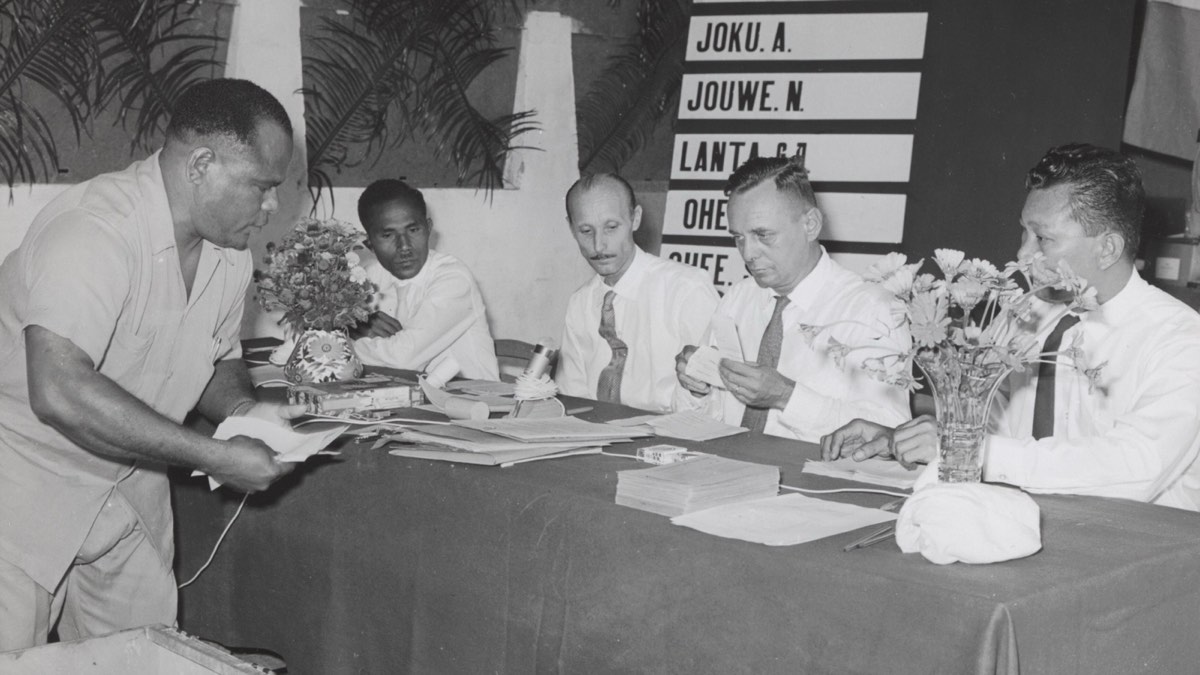
On 19 October 1961, about 72 Papuan leaders, Christian and Muslim, met in Hollandia and chose a 17-member National Committee, historian Richard Chauvel writes in Constructing Papuan Nationalism (East-West Center, 2005). The committee issued a political manifesto with four requests:
- a Papuan flag flown beside the Dutch flag;
- the song “Hai Tanahku Papua” sung with the Dutch anthem;
- the name “West Papua” for the territory;
- the name “Papuans” for its people.
The New Guinea Council, the territory’s partly elected advisory body, was divided, Chauvel records. Most members supported the manifesto, but some thought raising a flag was premature, and at least one opposed any immediate proclamation of independence.
According to Chauvel, the Dutch accepted the flag as a landsvlag, a territorial flag, not a nationale vlag, a national flag. They asked for the first raising to wait until 1 December. That way it would not look like a fait accompli while the UN was still debating the Luns plan, and would not unnecessarily provoke Indonesia. However, in late November the plan failed. Neither the Dutch proposal nor a rival draft from African states won the two-thirds majority it needed.
On 1 December 1961, Papuan leaders raised the flag beside the Dutch flag in front of the council building in Hollandia. The Dutch governor was present. Ceremonies were also held elsewhere in the territory, with strong local interest in places such as Biak and Serui. Chauvel reports no incidents.
Was 1 December 1961 a declaration of independence?
Historians and independence supporters read the day differently.
Independence supporters regard 1 December 1961 as the day Papuans declared their independence, and mark it as such.
Historian Richard Chauvel reaches a different conclusion. He writes that the manifesto and the flag ceremony “did not constitute a proclamation of independence”: the territory stayed under Dutch rule, and the Netherlands treated the flag as a territorial symbol. He adds that none of the Papuan politicians directly involved considered the ceremony an independence proclamation. In his account, nationalists of the reform era after President Suharto fell made the 1961 events the centrepiece of their history. This happened around the Papuan Congress of 2000. Chauvel adds that this nationalist reading of Papuan history is not shared by most Indonesians.
Eighteen days later, on 19 December 1961, President Sukarno announced Trikora, the People’s Triple Command. It was part of Indonesia’s campaign to take control of the territory.
How did Papua become part of Indonesia after 1961?
The Netherlands and Indonesia signed the New York Agreement on 15 August 1962. A temporary UN authority then administered the territory, and Indonesia took over administration on 1 May 1963. In the 1969 Act of Free Choice (Penentuan Pendapat Rakyat, or Pepera), just over 1,000 selected representatives voted unanimously and in public to remain with Indonesia, and the UN General Assembly took note of the outcome in Resolution 2504.
Indonesia regards Papua’s status as settled by these steps. By contrast, independence supporters dispute the 1969 vote, arguing that a small group of selected representatives voting in public did not amount to a free choice by the whole population. Our explainer How did Papua become part of Indonesia? sets out each step with sources.
Is 1 December the OPM’s anniversary?
Some reports describe 1 December as the founding date of the Free Papua Organisation (OPM). The Jakarta Post, for example, wrote in 2024 that “OPM was established on Dec. 1, 1961” (The Jakarta Post).
However, in Chauvel’s account, the National Committee and the New Guinea Council organised the 1961 ceremony under Dutch rule. Most accounts place the OPM’s origins later than 1961. Chauvel dates the start of the OPM revolts to 1965, and researcher Vidhyandika Perkasa, writing in Kompas, also gives 1965. Our explainer What are the OPM and TPNPB? covers the movement and its armed wing.
How has 1 December been marked in recent years?
In the reports we reviewed for 2023 to 2025, police named areas they considered vulnerable, increased patrols and urged residents not to be provoked. Media also reported protests and attempts to raise the flag in some cities.
| Date | What happened | Source |
|---|---|---|
| 30 November 2023 | Papua regional police named 13 regencies and cities as vulnerable ahead of 1 December and increased joint patrols with the military. | ANTARA |
| 1 December 2024 | A protest in Yogyakarta ended in a clash when police stopped a participant from raising the Morning Star flag. Police said officers were attacked. | The Jakarta Post |
| 21 November 2025 | Police in Sorong increased day and night patrols and said security in the city remained calm. | ANTARA |
| 30 November 2025 | The Jayapura police chief asked residents to stay calm and not be provoked. | ANTARA |
| 1 December 2025 | A Papuan student protest in Makassar turned rowdy when, Detik reported, some participants threw stones and water bottles at a police barricade. It calmed quickly. | Detik |
Moreover, security concerns around the date are not only about flags. In October 2025, Tempo reported that armed clashes between security forces and the armed group TPNPB had become more frequent in the months before 1 December (Tempo).
What does Indonesian law say about the Morning Star flag?
Two sets of rules are relevant.
- Regional symbols. Government Regulation 77 of 2007 bars regional governments from adopting a flag or logo that is essentially or wholly similar to that of a banned organisation or a separatist movement in Indonesia. Its official elucidation names the Morning Star flag as an example. The regulation governs what regional governments may adopt; we found no criminal penalty for individuals in its text (text, JDIH BKN).
- Treason (makar). English sources usually translate makar as treason. Under the old Criminal Code, article 106 covered attempts to separate part of Indonesia’s territory, and article 110 covered conspiracy to commit such acts. In 2019, Human Rights Watch reported that prosecutors had charged most of the 22 people then awaiting trial in four cities with treason under these two articles, including three students who had made Morning Star flags (HRW). Indonesia’s new Criminal Code, Law 1 of 2023, came into force on 2 January 2026 and replaced the old code (BPK legal database). The new code also contains treason provisions.
What does the Indonesian government say?
Indonesia considers Papua’s status settled. At the UN General Assembly in 2018, its representative Aloysius Selwas Taborat called it “final, irreversible and permanent”, referring to the 1969 UN resolution (The Guardian).
At the UN General Assembly on 28 September 2026, Indonesian diplomat Nona Gae Luna dismissed criticism from Solomon Islands and Vanuatu, which had called for independent UN verification in Papua, as “disinformation and misinformation”. She cited the abduction of nine people, most of them women and children, and said human rights concerns should not be used to “justify violence or advocate separatism” (The Jakarta Post).
On amnesty, the government has sent mixed signals, Human Rights Watch reported in February 2025. One minister, Yusril Ihza Mahendra, said Papuans convicted or awaiting trial could receive amnesty if they renounced violence and pledged allegiance to the state. About a week later another minister, Supratman Andi Agtas, said it would not cover people convicted of involvement in armed insurgencies (HRW).
What do human rights groups and Komnas HAM say?
Our report on human rights in West Papua covers the wider record. On 1 December specifically:
- Human Rights Watch argues that peacefully raising a flag is free expression and should not be prosecuted as treason. In February 2025 it cited the Papuans Behind Bars coalition, an NGO count rather than official data, as reporting 83 Papuans imprisoned on separatism charges, most of them for peacefully displaying the Morning Star flag (HRW).
- ELSAM, an Indonesian human rights organisation, described flying the flag as cultural expression rather than treason after the 2024 Yogyakarta protest (The Jakarta Post).
- Yan Christian Warinussy, a human rights lawyer in Manokwari, asked the government in November 2025 to stop what he called excessive security operations around the date, and to treat 1 December as a matter of history (Jubi).
- Komnas HAM, the state human rights commission, received at least 60 cases of alleged human rights violations in Papua between 1 January and 28 November 2025 and prioritised 20 of them (The Jakarta Post).
What do development figures show?
Papua’s provinces remain behind the rest of Indonesia on official measures. In 2026, Highland Papua had the country’s lowest Human Development Index score, 55.25, against a national score of 76.59. South Papua moved from the “medium” to the “high” category. Statistics Indonesia (BPS) released the figures on 5 November 2026, and CNBC Indonesia reported them. In March 2026, 30.41 per cent of people in Central Papua and 26.34 per cent in Highland Papua lived below the poverty line, compared with 8.07 per cent nationally, according to BPS (national release; provincial figures via Databoks).
Related reporting: village electricity, 4G towers and the Trans-Papua highway.
What happens next?
1 December 2026 will be the first under Indonesia’s new Criminal Code. We will update this explainer with how people mark the date this year.
Frequently asked questions
Is 1 December a public holiday in Indonesia?
No. It is not among the national holidays set for 2026 in the government’s joint ministerial decree (State Secretariat).
What is the Morning Star flag?
It is the flag first raised in Hollandia on 1 December 1961, which the Dutch accepted as a territorial flag. Indonesian regulation names it as an example of a separatist movement’s flag (Government Regulation 77 of 2007).
What is Trikora?
President Sukarno announced Trikora, the People’s Triple Command, on 19 December 1961, 18 days after the flag ceremony, as part of Indonesia’s campaign to take control of the territory from the Netherlands.
How this explainer was made: we researched and drafted it with the help of AI tools. Our editorial team then checked it against the linked sources and edited it before publication. Corrections: [email protected].