The OPM (Organisasi Papua Merdeka, or Free Papua Movement) is the umbrella name for the movement seeking independence for Papua from Indonesia, which emerged in the 1960s. Meanwhile, the TPNPB (West Papua National Liberation Army) is its armed wing, a loose network of factions. In 2021, Indonesia designated armed Papuan separatists as terrorists.
Is Papua Movement connected to the OPM?
No. Papua Movement (papuamovement.com) is an English-language news and analysis publication of the Youth Foundation for Indonesian Peace (YPPI). Despite the similar name, it has no affiliation with the Free Papua Movement (OPM), the TPNPB, the ULMWP or any armed group. For details, see About Papua Movement and our Editorial Policy.
👉 ALSO READ: Why Do Some Papuans Seek Independence?
What is the OPM?
To begin with, the OPM is the oldest name associated with Papuan independence. However, sources differ on its founding date: Wikipedia dates it to December 1963 (Free Papua Movement), while researcher Vidhyandika Perkasa, writing in Kompas, gives 1965 (Kompas). Over the decades, it has also combined diplomacy with armed actions, and rivalries among its leaders split it into factions in the 1970s (Free Papua Movement).
Today, therefore, “OPM” is less a single organisation than a label that many groups use. For example, the Institute for Policy Analysis of Conflict (IPAC), a Jakarta-based research group, describes the armed OPM as “a highly decentralised collection of autonomous units”. According to IPAC, these units are most active in the central highlands, and clan, geography and personal rivalries divide them (IPAC).
What is the TPNPB?
The TPNPB (Tentara Pembebasan Nasional Papua Barat, or West Papua National Liberation Army) is the military wing of the OPM, which consists of separate armed factions. In 2023, Reuters estimated that it had about 500 fighters (Reuters). Each faction has its own commander; for example, Egianus Kogoya leads one of the best known, in the Nduga area (Reuters). In addition, its spokespeople often use the name TPNPB-OPM (Free Papua Movement).
In 2015, IPAC assessed that the armed OPM “has never constituted a serious military threat to the Indonesian state, but neither is it going to go away” (IPAC). Nevertheless, Reuters reported in 2023 that attacks had become more frequent and deadly since 2018, partly because fighters obtained better weapons through raids on army posts and the black market (Reuters).
What attacks has the TPNPB been linked to?
| Year | Incident | Source |
|---|---|---|
| 2018 | A separatist group killed 21 road construction workers in Nduga | Reuters |
| 2021 | Rebels killed a regional intelligence chief in an ambush in the highlands | Reuters |
| 2023–2024 | A TPNPB faction led by Egianus Kogoya held New Zealand pilot Phillip Mehrtens for more than 19 months until his release in September 2024 | Reuters |
Sources: Reuters, 2023; Reuters, 2024.
How has the violence affected Papuan civilians?
In particular, armed attacks have repeatedly hit people who provide basic services in remote areas, including teachers and health workers:
- Teachers in Beoga, Puncak (April 2021). Armed separatists shot dead two teachers, Oktovianus Rayo and Yonathan Renden. Papua’s provincial government later honoured them for their work educating Papuan children in the highlands (Antara).
- Health workers in Kiwirok, Pegunungan Bintang (September 2021). Attackers burnt down the Kiwirok community health centre. According to officials, they also assaulted health workers, and a nurse, Gabriela Meilan, died after falling into a ravine while fleeing (Tempo).
- Teachers in Yahukimo (March 2025). Gunmen attacked a housing complex for educators, killing a teacher and injuring six others. A TPNPB commander claimed responsibility and alleged the teachers were military intelligence operatives. However, Candra Kurniawan, a spokesman for the Indonesian military in Papua, said the victims were “educators and medical personnel – not spies” (BenarNews).
As a result, these attacks fall on services that remote highland communities depend on. After the Beoga killings, Papua’s provincial secretary, Yulian Dance Flassy, said attacks on teachers must never happen again (Antara). For their part, separatists have accused the government of using teachers and health workers for surveillance, a claim officials reject (BenarNews).
Security forces have also harmed civilians. For example, in March 2024 the Indonesian army apologised and arrested 13 soldiers after a video showed troops torturing a Papuan man (Reuters). For wider human rights concerns, see Why Do Some Papuans Seek Independence?
Does Indonesia consider them terrorists?
Yes. In April 2021, after rebels killed a regional intelligence officer, Indonesia formally designated Papuan separatists as “terrorists”. Specifically, chief security minister Mahfud MD said organisations and people in Papua “who commit massive violence can be classified as terrorists” under a 2018 counter-terrorism law (Reuters). In addition, the government calls the armed groups “Kelompok Kriminal Bersenjata” (KKB), or “armed criminal groups” (Reuters).
However, rights groups raised concerns. Human Rights Watch researcher Andreas Harsono said the designation could open “more possibilities of abuses”, and Amnesty International Indonesia’s Usman Hamid said it could curb free speech and association. Meanwhile, TPNPB spokesperson Sebby Sambom rejected the designation (Reuters).
How are the OPM and TPNPB different from the ULMWP?
In contrast, the United Liberation Movement for West Papua (ULMWP) is a political and diplomatic coalition, not an armed group. Specifically, three diaspora-led independence organisations formed it in December 2014 in Vanuatu. Their aim was to join the Melanesian Spearhead Group, a regional body of Pacific states, which later gave the coalition observer status (IPAC).
| OPM | TPNPB | ULMWP | |
|---|---|---|---|
| What it is | Umbrella independence movement | Armed wing of the OPM | Political and diplomatic coalition |
| Origins | 1960s (1963 or 1965, by different accounts) | Grew from the OPM’s armed units | Formed December 2014 in Vanuatu |
| Main methods | Diplomacy and armed actions | Armed attacks, hostage-taking | Lobbying, mainly among Pacific states |
Sources: Wikipedia; IPAC; Reuters.
Finally, for the reasons behind the independence movement, see Why Do Some Papuans Seek Independence?, and for its history, How Did Papua Become Part of Indonesia?
Sources
- Reuters: Indonesia designates Papuan separatists ‘terrorists’ (29 April 2021)
- Reuters: Separatist insurgency in Indonesia’s Papua region (23 February 2023)
- Reuters: New Zealand pilot Phillip Mehrtens freed from captivity in Indonesia’s Papua (21 September 2024)
- Antara: Two slain teachers in Papua’s Beoga receive Education Award (3 May 2021)
- Tempo: Kiwirok Attack: Missing Health Worker Found, Escorted to Sentani (26 September 2021)
- BenarNews: Papua rebels kill teacher, injure 6 accused of spying for Indonesian military (24 March 2025)
- Reuters: Indonesian army apologises after viral Papua torture video (25 March 2024)
- Institute for Policy Analysis of Conflict (IPAC): The Current Status of the Papuan Pro-Independence Movement (24 August 2015)
- Kompas: Papua and Neglect on the Conflict-Development Nexus, by Vidhyandika D. Perkasa (21 March 2022)
- Wikipedia: Free Papua Movement
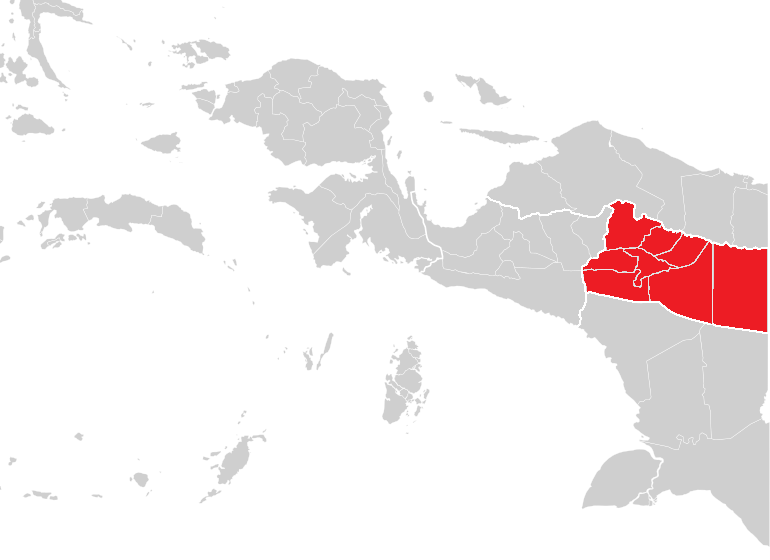
Featured image: Map of Highland Papua province (2022), part of the central highlands. Map: Wikimedia Commons contributor, based on work by Hddty / Wikimedia Commons (cropped), CC BY-SA 4.0.