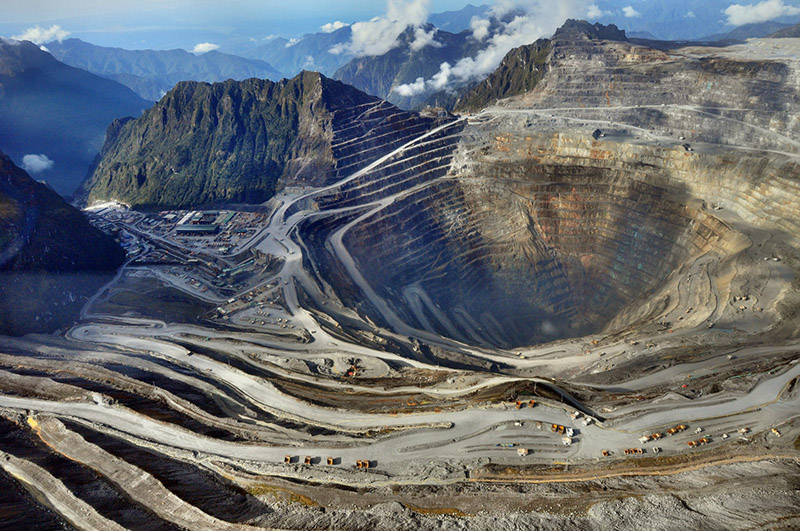
The Grasberg mine in Mimika, Central Papua, is one of the world’s largest copper and gold mines, and since 2018 Indonesia has owned the majority of it. In 2025, its operator paid Rp75 trillion to the state, including Rp13.48 trillion to local governments in Papua. However, critics point to environmental damage and human rights concerns.
👉 ALSO READ: Why Did Indonesia Create New Provinces in Papua?
Grasberg mine at a glance
In short, these are the key facts about the mine.
| Item | Detail | Source |
|---|---|---|
| Location | Mimika Regency, Central Papua | PTFI |
| Operator | PT Freeport Indonesia (PTFI) | Reuters |
| Ownership | Indonesian state (MIND ID) 51.24%; Freeport-McMoRan 48.76% | PBI-UK |
| Price of majority stake | US$3.85 billion (December 2018) | Reuters |
| Payments to the state, 2025 | Rp75 trillion, including Rp13.48 trillion for local governments | PTFI |
| Social investment, 2025 | Rp2 trillion | PTFI |
| Indigenous Papuan workers | 40.9% of mine-site workers (July 2024, company data) | CNN Indonesia |
| Sales, 2025 | 1.2 billion pounds of copper and 1.1 million ounces of gold | PTFI |
Sources: Reuters; PTFI; CNN Indonesia; PBI Canada.
Who owns the Grasberg mine?
For decades, the US company Freeport-McMoRan controlled the mine. Then, in December 2018, the state miner Inalum paid US$3.85 billion and took a 51.23% stake in PT Freeport Indonesia. President Joko Widodo called it “a historical moment since Freeport began operating in Indonesia in 1973” (Reuters).
As part of the deal, Freeport also agreed to build a copper smelter in Indonesia and to invest about US$14 billion in the mine. In addition, its new permit can run to 2041 (Reuters).
Papua also holds a share. Specifically, the Papua provincial government and Mimika Regency receive dividends from the company as shareholders, according to PTFI (PTFI).
How much does Papua earn from the mine?
Overall, the sums are large. In 2025, PTFI paid Rp75 trillion to the state in taxes, royalties, dividends and other payments. Of this, for example, Rp16.9 trillion went as dividends to MIND ID, the state shareholder. Meanwhile, local governments received Rp13.48 trillion (PTFI).
In particular, part of the money comes from a legal share of the company’s net profit. For example, in April 2026 PTFI paid Rp4.8 trillion from its 2025 profit, and most of it stayed in Papua:
| Recipient | Amount | Share of net profit |
|---|---|---|
| Central government | Rp1.92 trillion | 4% |
| Central Papua province | Rp720.5 billion | 1.5% |
| Mimika Regency | Rp1.2 trillion | 2.5% |
| Seven other regencies in Central Papua | Rp137.2 billion each (Rp960.4 billion in total) | 2% |
Source: PTFI. The seven regencies are Nabire, Paniai, Puncak, Puncak Jaya, Dogiyai, Deiyai and Intan Jaya.
What does the Grasberg mine do for local communities?
First, the company funds health and education. In 2025, its social investment reached Rp2 trillion, and it plans about US$100 million a year until 2041 (PTFI). For instance, members of seven local tribes can get free treatment at its hospital and clinics. The company also runs a boarding school for Papuan students (PTFI).
Second, the mine provides jobs. According to company data, 2,334 of the 5,703 workers at the mine site in July 2024, or 40.9%, were Indigenous Papuans. In addition, the company says nine Papuans serve as directors and more than 100 hold management posts (CNN Indonesia).
What are the main criticisms of the Grasberg mine?
Nevertheless, the mine has long faced criticism, mainly on four issues.
First, there is the environment. An audit by the national audit agency (BPK) estimated that tailings, the waste from the mine, had cost Rp185 trillion in lost ecosystem services. However, in 2018 BPK said this was not a loss to the state, and the figure needed further review. BPK also found that the mine used at least 4,535.93 hectares of protected forest without a permit. As a result, the environment ministry and the company began preparing a road map to manage the waste (CNN Indonesia).
Second, there are human rights concerns. In October 2026, Peace Brigades International UK cited the mine as a site of “serious and sustained human rights violations against local communities and activists” (PBI Canada).
Third, there is safety. Specifically, on 8 September 2025, about 800,000 tonnes of wet material flooded the Grasberg Block Cave, one of the underground mines, and killed seven workers. Afterwards, the government investigated and gave the company recommendations to improve safety (Reuters).
Finally, there is security. For example, in February 2026 an attack on a Freeport convoy near Tembagapura killed a soldier, and the armed group TPNPB claimed it (Reuters).
What comes next?
Above all, the mine is still recovering from the 2025 accident. In May 2026, PTFI said production was at about 40 to 50% and should return to full capacity in early 2028 (PTFI). Therefore, payments to Papua could grow again as output recovers. Papua Movement will follow how that money is used in Mimika and Central Papua.
Sources
- Reuters: Indonesia closes long-awaited $3.85 billion Freeport deal (21 December 2018)
- Reuters: Freeport Indonesia says investigation concluded on Grasberg incident (7 November 2025)
- Reuters: Two killed after civilian airplane shot while landing in Indonesia’s Papua, police say (11 February 2026)
- PT Freeport Indonesia: Freeport Setor Rp75 Triliun ke Negara (7 May 2026) (in Indonesian)
- PT Freeport Indonesia: Freeport Klaim Setor Rp7 T Tiap Tahun untuk Kabupaten Mimika (28 September 2022) (in Indonesian)
- CNN Indonesia: Freeport Komitmen Perluas Kesempatan Kerja bagi Orang Asli Papua (3 March 2026) (in Indonesian; company statement)
- CNN Indonesia: BPK: Kerusakan Ekosistem Akibat Freeport Tak Rugikan Negara (22 October 2018) (in Indonesian)
- Peace Brigades International Canada: PBI-UK “Overdue Diligence” report cites five case studies (22 October 2026)
Featured image: The Grasberg open-pit mine in Mimika, Papua (2017). Photo: Ministry of Energy and Mineral Resources of Indonesia, Wikimedia Commons, public domain.